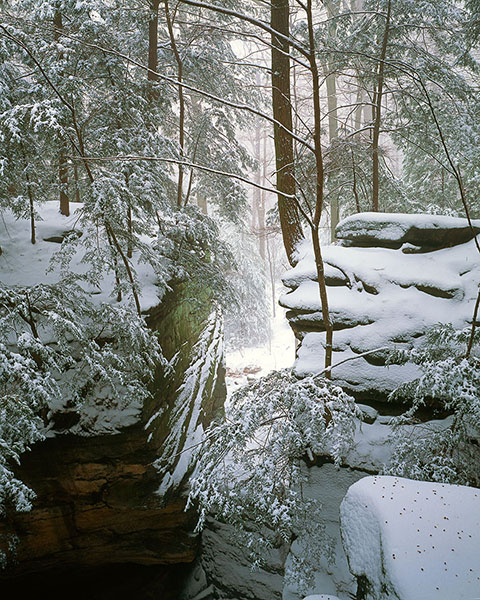
Yesterday morning I awoke to see several inches of wet snow covering the ground as a late winter snowstorm moved through the Buckeye State. The snow clung to the trees, creating picturesque conditions that soon had me on the road, heading to one of my favorite locations for winter photography in northeast Ohio, the Ritchie Ledges in Cuyahoga Valley National Park. When I arrived at the Ledges at 9:30 am the only other vehicle in the parking area was a snow plow, and although I followed a trail of footprints along the Ledges hiking trail I had the place to myself for the next couple of hours. I followed the trail through the woods for about a quarter of a mile until it passed through a forest of young hemlock trees near the top of the Ritchie Ledges, a mile long escarpment of sandstone cliffs, averaging 30-40 feet in height, carved from Sharon Conglomerate rock formed more than 300 million years ago during the Pennsylvanian age.
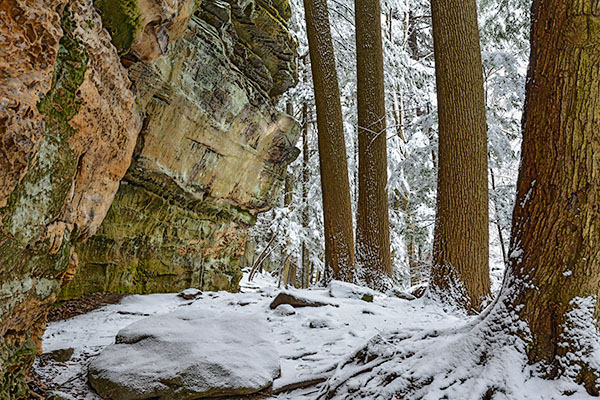
The trail descends to the base of the cliffs, and passes by Icebox Cave, a deep recess in the sandstone ledges. A little further along the trail is one of my favorite places, where several very large hemlock trees tower over the trail.
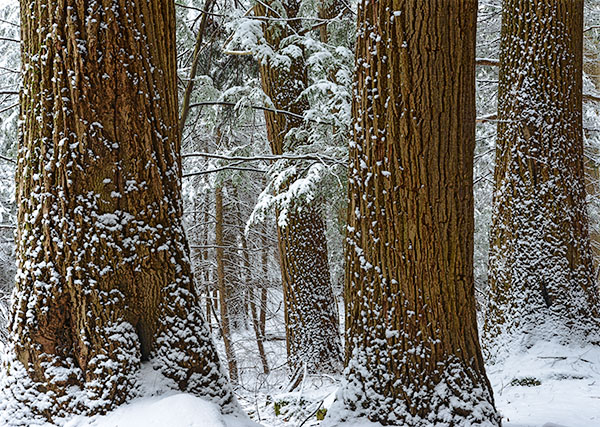
I have a strong preference for cloudy skies when photographing in woodlands, which are visually chaotic places with an abundance of subjects that can be hard to compose. Direct sunlight adds to this complexity and increases contrast by washing out highlights in the snow and rendering shadows inky black. I worked quickly, as the wind began to dislodge snow from the branches of the hemlocks and the temperature hovered around the freezing mark; a few degrees warmer and the snow would start to melt.
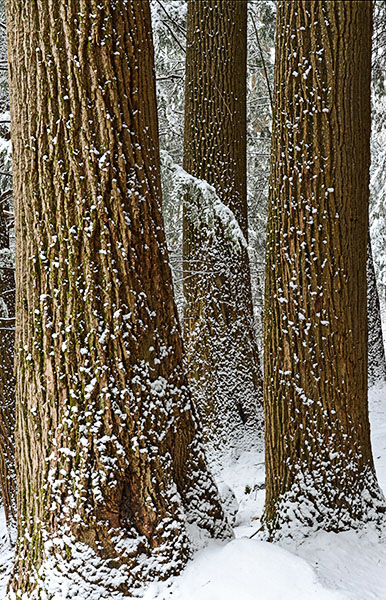
Although I like the low contrast lighting provided by overcast skies, I try to keep the sky out of the composition as far as possible since the patches of white are visually distracting. Pay special attention to the spacing between the trees and adjust your position so that the trees are juxtaposed in a balanced manner in the picture frame. When you find an attractive subject, such as the giant hemlocks shown above, explore horizontal as well as vertical compositions.
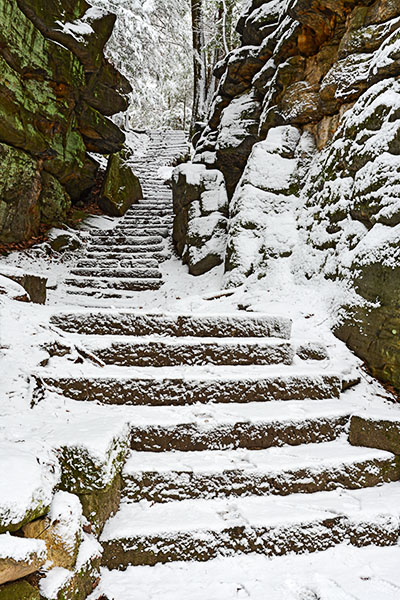
A few hundred feet further along the trail, a picturesque set of stone steps, built by the Civilian Conservation Corps during the 1930s, leads up to the top of the escarpment, while the main Ledges Trail continues along the base of the cliffs.
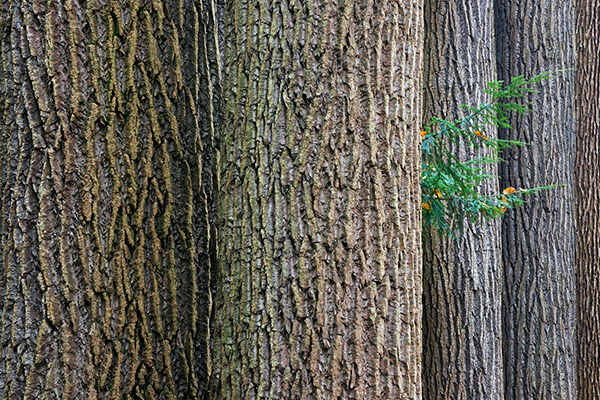
In addition to the large hemlock trees, some very big tulip trees grow near the Ledges Trail. I used a 400mm lens to create the photograph shown above, of five tulip trees and a hemlock branch along this section of the trail.

There are many large trees growing along the Ledges Trail below the cliffs, and some of them have unusual bark patterns, such as the birch tree shown in the photograph above.
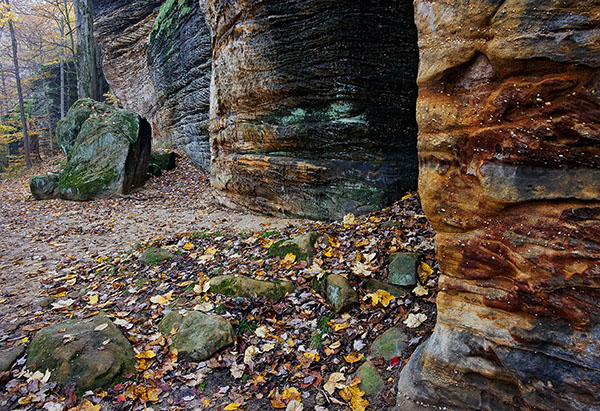
The Ritchie Ledges extend for more than a mile and provide numerous opportunities for scenic photography. Many sections of rock have white quartz pebbles, called “lucky stones” or “poor man’s pearls”, embedded in the surface of the sandstone.
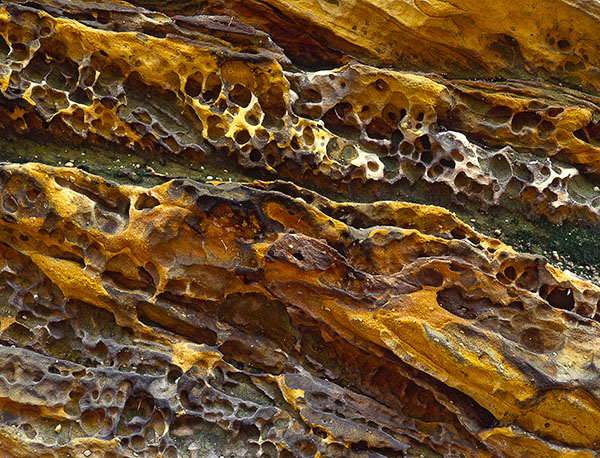
In places the surface of the ledges are honeycombed with pockets, swirls, and other picturesque patterns. To create more dynamic compositions when photographing these rock features, try tilting your camera so that the main lines of the strata are aligned with a diagonal within the picture frame, rather than parallel to the edges, which tends to be more static.
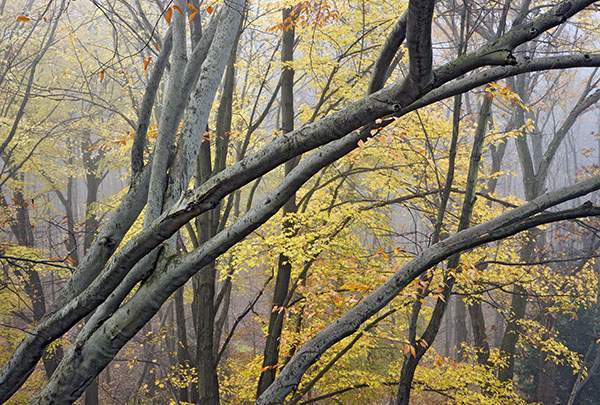
Eventually the Ledges Trail reaches the end of the cliffs and circles back to the top of the rock escarpment. There is an overlook here where you can see for miles, but most of the view is blocked by the trees below the cliffs and I don’t find the overlook very interesting from a compositional viewpoint. However, there are many attractive views looking down into the woods from the top of the cliffs, especially in fall or on a misty day.
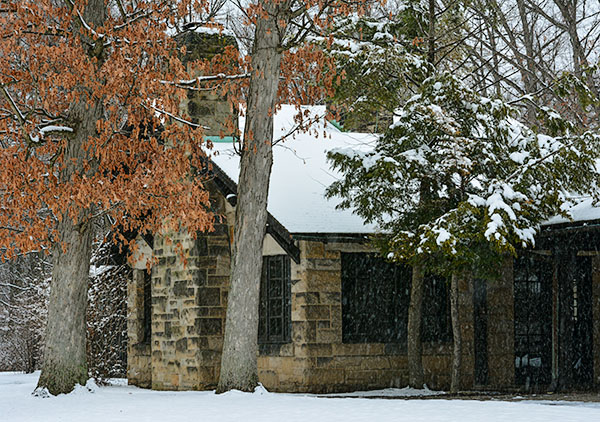
Next to the parking area is a shelter, built from chestnut timber and sandstone by the Civilian Conservation Corps during the 1930s. The shelter is a great place for a picnic, and may be rented for special occasions.
The Ritchie Ledges in Cuyahoga Valley National Park offer many opportunities for scenic photography in every season, as well as close-ups of wildflowers, ferns, and mushrooms during the warmer months.
Ritchie Ledges may be reached from Truxel Road. The Ledges shelter GPS coordinates are: 41.224178N 81.510525W. The Ledges Trail may also be reached from the Haskell Run Trail, which begins at Happy Days Visitor Center, 500 W. Streetsboro Rd (Rte. 303), Peninsula, OH 44264. the GPS coordinates for the Happy Days Center are: 41.230274N 81.508819W.
Jeffrey Gibson
26 Mar 2013Great tour Ian…knowing where everything is made it feel as though I was walking with you.
ianadams1
26 Mar 2013Thanks, Jeff. I loved your textured photo of the great blue heron nest on Bath Road – like a Chinese brush painting.
Susan
26 Mar 2013Beautiful and thank you for the lesson. We love the Cuyahoga and visit every time we visit our daughter in Hudson.
LeeAnn Shively Swonguer
26 Mar 2013Stunning photos Ian. Love the stories with the pictures as well. Thank you so much for sharing!