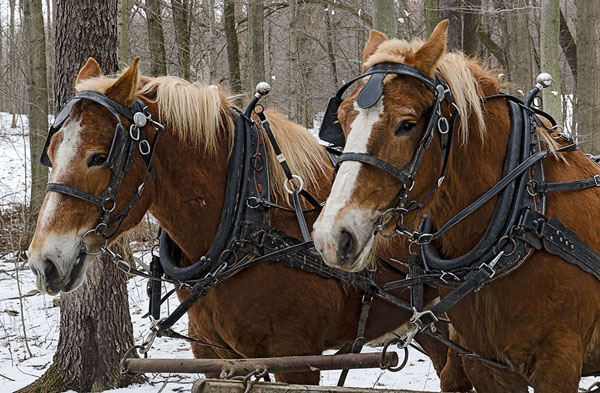
Earlier this year, at my icicles and frozen waterfalls photo tour, I met Rick Karges, who is the Executive Director of Hopewell Farm, a 300-acre therapeutic farm community for adults with serious mental illness located near Mesopotamia in Trumbull County, Ohio. The residents, most of whom stay at Hopewell for several months, work in teams and carry out all aspects of the farm’s daily work. Trumbull County has a large Amish farming community, and Hopewell’s farm manager, Norman Wengerd, is Amish and lives nearby in Mesopotamia. Each spring several hundred maple trees in the woodlands at Hopewell are tapped for maple sap, which is used to produce several hundred gallons of maple syrup that is sold in the local community. Rick invited me to visit Hopewell and photograph the maple sugaring activities.
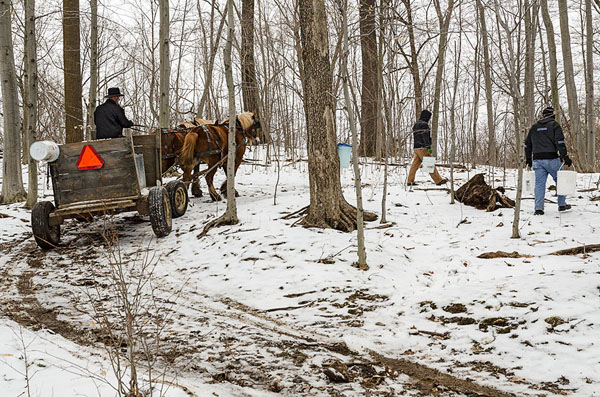
Hopewell’s two Belgian horses, Bella and Ben, are used to pull the wagon that carries the maple sap tank through the woods. Belgian horses are immensely strong, and Belle and Bess’s combined weight of almost 4,000 pounds provides some serious pulling power along the muddy woodland dirt roads. Many maple sugaring farms now use tractors, but I suspect that horses’ hooves do less damage to the woodland roads, and the horses are able to turn on a dime in response to Norman Wengerd’s commands. They also have a smaller carbon footprint, since the horses eat hay and no fossil fuels are used to gather the maple sap. This year about 1500 taps were placed in the maple trees, and the sap collecting took place over several weeks, from mid-March through early April. Cold nights followed by warmer days, with daytime temperatures in the forties, are needed for the sweet maple sap to rise from the roots of the trees to the taps, where it is collected in plastic buckets.
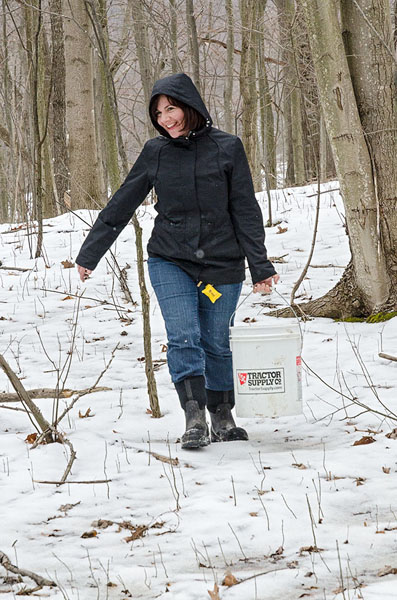

When the tank is full, it is taken to a large storage tank in the woods, equipped with plastic lines that carry the sap, using gravity, to another storage tank at Hopewell’s sugar house. When the sap is flowing freely, the crew works all day and the horse-drawn wagon makes many visits to the maple woods.
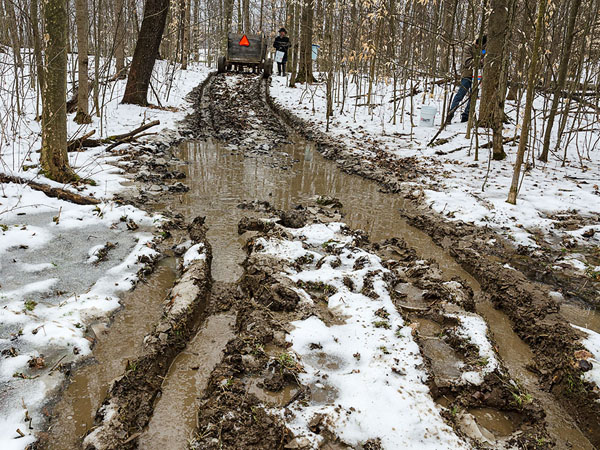
The wagon and horse’s hooves combine with melting snow to create ruts filled with mud, and rubber boots are essential footwear for the sap collection team.
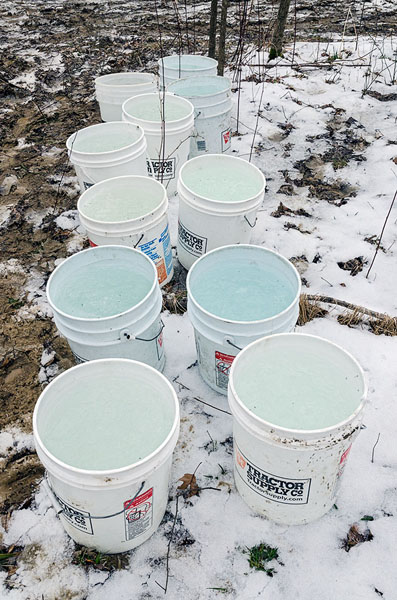
On a good day, several hundred gallons of maple sap are collected from Hopewell’s woods. The sap is a clear liquid, with no tinge of the golden hue that characterizes the finished maple syrup.
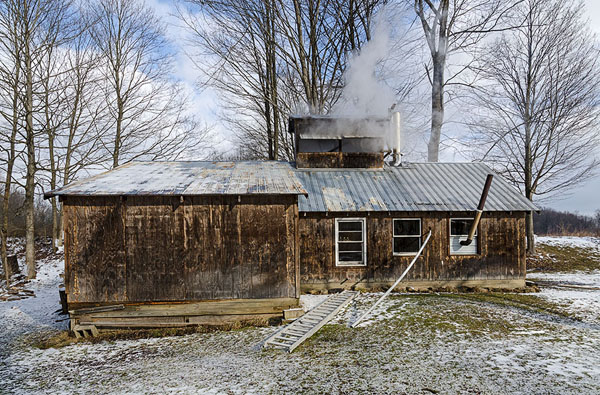
It takes 40-50 gallons of maple sap to produce a gallon of finished maple syrup. The maple sap is processed in Hopewell’s sugar house, which is located on the edge of the woods.
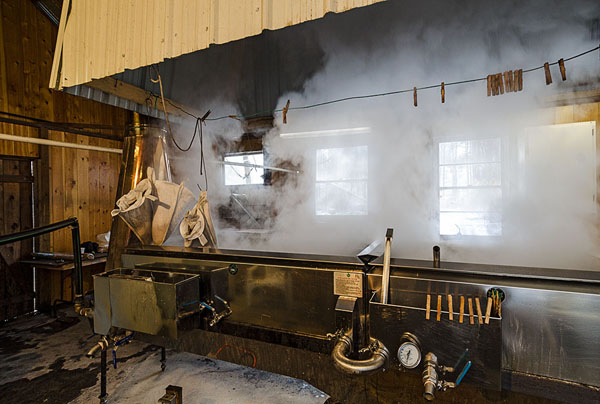
Native American Indians collected maple sap in birch bark buckets, and dropped hot stones into the buckets to evaporate water and concentrate the syrup. Today, wood-fired metal evaporators are used.
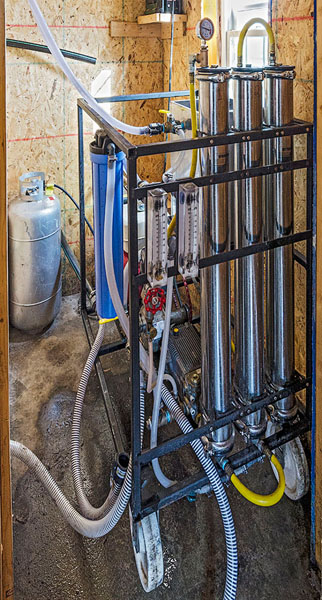
Before the sap is boiled, it is passed though a reverse osmosis machine, which removes as much as 50 percent of the water.
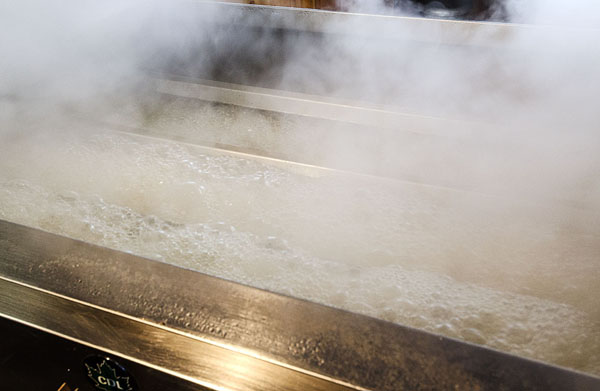
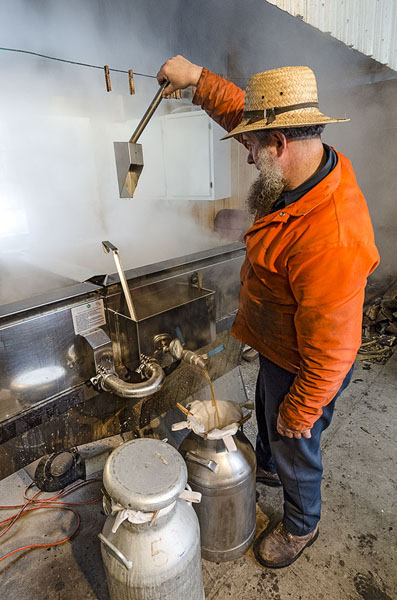
The temperature and density of the boiling liquid are critical factors in maple syrup production, and temperature gauges and hygrometers are monitored constantly during the production process. In the photo above, Hopewell’s farm manager, Norman Wengerd, judges the consistency of the maple syrup by the way it drips from a metal scoop.
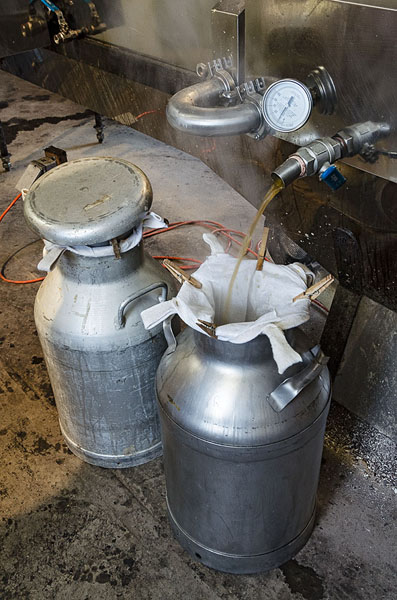
The finished maple syrup is poured through cloth filters into milk containers before being bottled for sale.

Early season maple syrup is light in color, with a delicate taste. As the season progresses, the syrup becomes darker, with a more intense maple flavor.
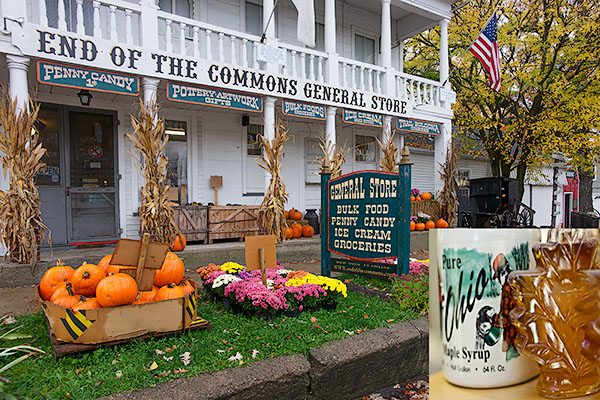
This season Norman Wengerd expects to produce about 275 gallons of maple syrup at Hopewell Farm, which will be sold in local stores like the End of the Commons General Store in Mesopotamia.
I would like to thank Rick Karges, Norman Wengerd and all the staff I met during my visits to Hopewell Farm for their help and hospitality. More information on Hopewell Farm may be obtained from their website: www.hopewell.cc